- 在線時間
- 5498 小時
- 最後登錄
- 26-7-8
- 國民生產力
- 74
- 附加生產力
- 90275
- 貢獻生產力
- 0
- 註冊時間
- 06-10-23
- 閱讀權限
- 10
- 帖子
- 31609
- 主題
- 292
- 精華
- 3
- 積分
- 121958
- UID
- 107125
 
|
Teaching (the learning environment): 30%
Reputation survey: 15%
The Academic Reputation Survey (run annually) that underpins this category was carried out in December 2014 and January 2015. It examined the perceived prestige of institutions in teaching. The responses were statistically representative of the global academy’s geographical and subject mix.
Staff-to-student ratio: 4.5%
Doctorate-to-bachelor’s ratio: 2.25%
Doctorates awarded-to-academic staff ratio: 6%
As well as giving a sense of how committed an institution is to nurturing the next generation of academics, a high proportion of postgraduate research students also suggests the provision of teaching at the highest level that is thus attractive to graduates and effective at developing them. This indicator is normalised to take account of a university’s unique subject mix, reflecting that the volume of doctoral awards varies by discipline.
Institutional income: 2.25%
This measure of income is scaled against staff numbers and normalised for purchasing-power parity. It indicates an institution’s general status and gives a broad sense of the infrastructure and facilities available to students and staff.
Research (volume, income and reputation): 30%
Reputation survey: 18%
The most prominent indicator in this category looks at a university’s reputation for research excellence among its peers, based on the responses to our annual Academic Reputation Survey.
Research income: 6%
Research income is scaled against staff numbers and adjusted for purchasing-power parity (PPP). This is a controversial indicator because it can be influenced by national policy and economic circumstances. But income is crucial to the development of world-class research, and because much of it is subject to competition and judged by peer review, our experts suggested that it was a valid measure. This indicator is fully normalised to take account of each university’s distinct subject profile, reflecting the fact that research grants in science subjects are often bigger than those awarded for the highest-quality social science, arts and humanities research.
Research productivity: 6%
We count the number of papers published in the academic journals indexed by Elsevier’s Scopus database per scholar, scaled for institutional size and normalised for subject. This gives a sense of the university’s ability to get papers published in quality peer-reviewed journals.
Citations (research influence): 30%
Our research influence indicator looks at universities’ role in spreading new knowledge and ideas.
We examine research influence by capturing the number of times a university’s published work is cited by scholars globally, compared with the number of citations a publication of similar type and subject is expected to have. This year, our bibliometric data supplier Elsevier examined more than 51 million citations to 11.3 million journal articles, published over five years. The data are drawn from the 23,000 academic journals indexed by Elsevier’s Scopus database and include all indexed journals published between 2010 and 2014. Only three types of publications are analysed: journal articles, conference proceedings and reviews. Citations to these papers made in the six years from 2010 to 2015 are also collected.
The indicator is always defined with reference to a global baseline and intrinsically accounts for differences in citation accrual over time, differences in citation rates for different document types (reviews typically attract more citations than research articles, for example) as well as subject-specific differences in citation frequencies overall and over time and document types. It is one of the most sophisticated indicators in the modern bibliometric toolkit.
The citations help to show us how much each university is contributing to the sum of human knowledge: they tell us whose research has stood out, has been picked up and built on by other scholars and, most importantly, has been shared around the global scholarly community to expand the boundaries of our understanding, irrespective of discipline.
The data are fully normalised to reflect variations in citation volume between different subject areas. This means that institutions with high levels of research activity in subjects with traditionally high citation counts do not gain an unfair advantage.
This year we have removed the very small number of papers (649) with more than 1,000 authors from the citations indicator.
In previous years we have further normalised citation data within countries, with the aim of reducing the impact of measuring citations of English language publications. The change to Scopus as a data source has allowed us to reduce the level to which we do this. This year, we have blended equal measures of a country-adjusted and non-country-adjusted raw measure of citations scores. This reflects a more rigorous approach to international comparison of research publications.
International outlook (staff, students, research): 7.5%
International-to-domestic-student ratio: 2.5%
International-to-domestic-staff ratio: 2.5%
The ability of a university to attract undergraduates, postgraduates and faculty from all over the planet is key to its success on the world stage.
International collaboration: 2.5%
In the third international indicator, we calculate the proportion of a university’s total research journal publications that have at least one international co-author and reward higher volumes. This indicator is normalised to account for a university’s subject mix and uses the same five-year window as the “Citations: research influence” category.
Industry income (knowledge transfer): 2.5%
A university’s ability to help industry with innovations, inventions and consultancy has become a core mission of the contemporary global academy. This category seeks to capture such knowledge-transfer activity by looking at how much research income an institution earns from industry (adjusted for PPP), scaled against the number of academic staff it employs.
The category suggests the extent to which businesses are willing to pay for research and a university’s ability to attract funding in the commercial marketplace – useful indicators of institutional quality.
Subject tables
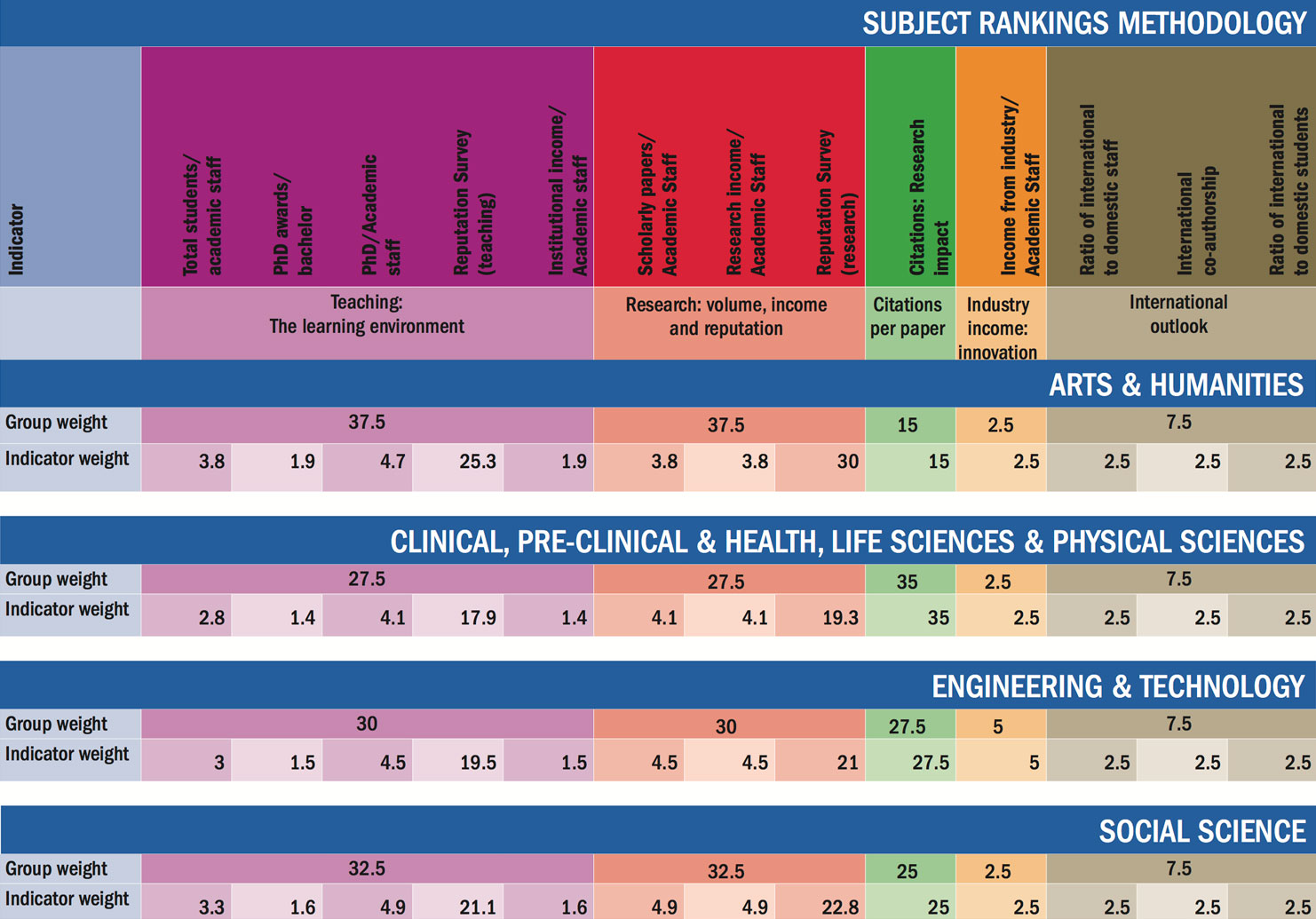
The subject tables employ the same range of 13 performance indicators used in the overall World University Rankings, brought together with scores provided under the same five categories.
However, we continue the three differences from the main World University Rankings methodology:
Weightings recalibrated:
Here, the overall methodology is carefully recalibrated for each subject, with the weightings changed to best suit the individual fields. In particular, those given to the research indicators have been altered to fit more closely the research culture in each subject, reflecting different publication habits: in the arts and humanities, for instance, where the range of outputs extends well beyond peer-reviewed journals, we give less weight to paper citations.
Accordingly, the weight given to “citations: research influence” is halved from 30 per cent in the overall rankings to just 15 per cent for the arts and humanities. More weight is given to other research indicators, including the Academic Reputation Survey. For social sciences, where there is also less faith in the strength of citations alone as an indicator of research excellence, the measure’s weighting is reduced to 25 per cent.
By the same token, in those subjects where the vast majority of research outputs come through journal articles and where there are high levels of confidence in the strength of citations data, we have increased the weighting given to the research influence (up to 35 per cent for the physical and life sciences and for the clinical, pre-clinical and health tables).
https://www.timeshighereducation ... ng-methodology-2016 |
|








 發表於 15-10-16 15:05